Learning to navigate change with awareness and choice
Every few years I find myself drawing the same picture again.
Not because I haven’t figured it out.
Because each version helps me see something I couldn’t see before.
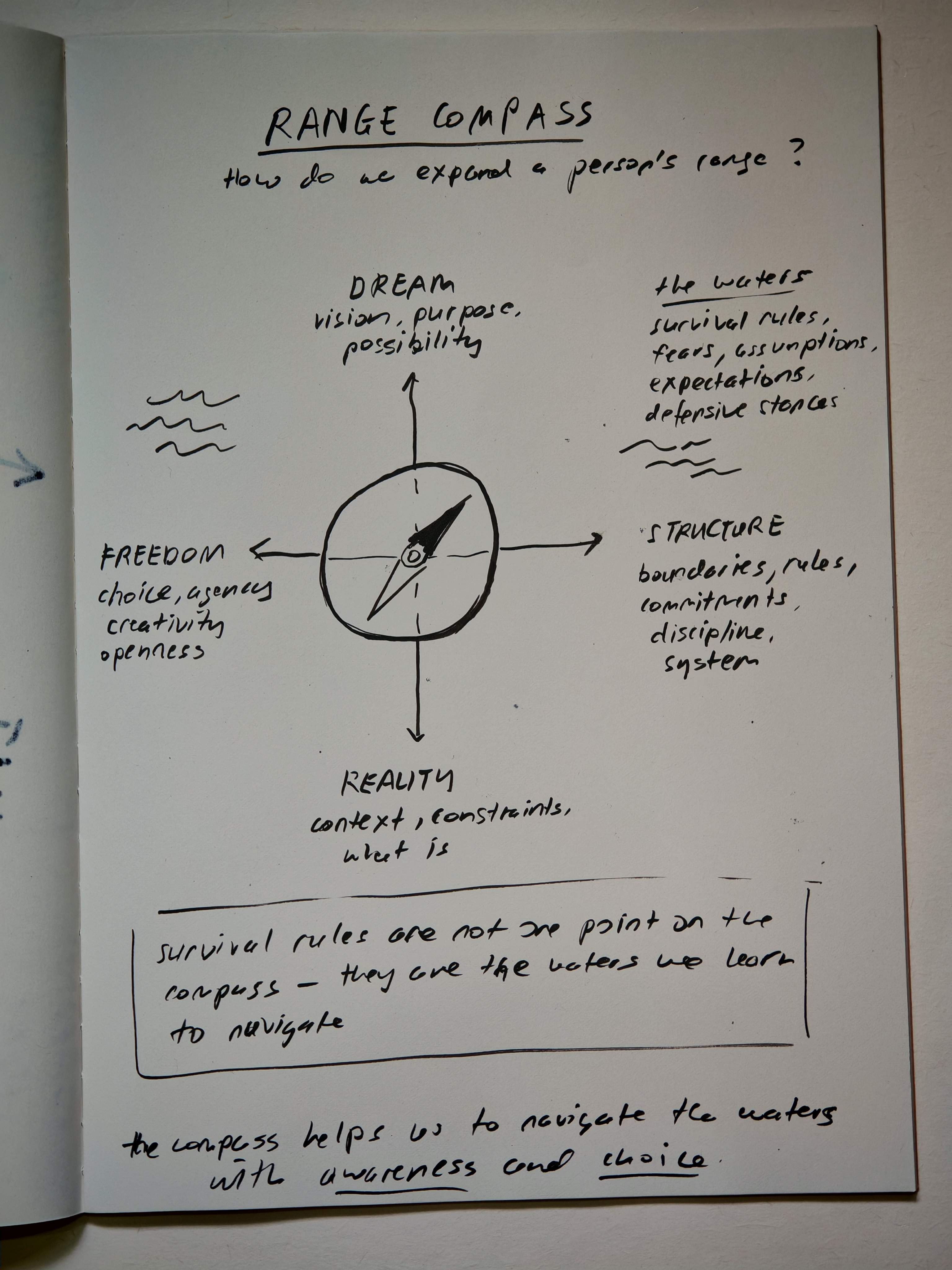
The latest sketch became what I’m now calling The Range Compass.
It isn’t a personality model.
It isn’t a leadership assessment.
It isn’t another framework that tries to categorise people into boxes.
It is a way of exploring the tensions we navigate every day.
Whether we are facilitating a difficult conversation, leading a team, making a life decision or simply trying to understand ourselves, we are constantly moving between different ways of seeing the world.
The question isn’t which one is right.
The question is whether we have enough range to move intentionally between them.
Two tensions every person navigates
At the heart of the Range Compass are two simple dimensions.
Dream ↔ Reality
Dream represents vision.
Purpose.
Hope.
Possibility.
The ability to imagine what does not yet exist.
Reality represents context.
Constraints.
Resources.
Relationships.
What is actually happening.
Healthy leadership needs both.
Dream without reality becomes fantasy.
Reality without dream becomes resignation.
Freedom ↔ Structure
Freedom is about choice.
Agency.
Creativity.
Experimentation.
The willingness to explore.
Structure is about boundaries.
Commitments.
Practice.
Discipline.
Systems.
Freedom without structure struggles to sustain itself.
Structure without freedom slowly becomes rigidity.
Again, neither side is better.
The art lies in knowing when each is needed.
Then I realised something important.
For a long time I wondered where Survival Rules belonged.
Should they sit opposite Freedom?
Should they become another axis?
The more I reflected through Satir, Gestalt and facilitation work, the less that made sense.
Survival Rules aren’t a destination.
They aren’t somewhere we’re trying to get to.
Instead…
they are the waters we are already swimming in. (Thanks to Mario Van der Meulen for his thoughts on this)
The waters we navigate
Every one of us carries assumptions that once helped us survive.
Perhaps we learnt:
- Don’t make mistakes.
- Don’t upset people.
- Don’t ask for help.
- Stay useful.
- Stay invisible.
- Stay in control.
These rules often protected us when we needed them.
The problem isn’t that they exist.
The problem is when we mistake them for reality.
They quietly shape what we notice.
- How we respond.
- Which direction feels safe.
- Which direction feels impossible.
This is why two people can experience exactly the same situation and navigate it completely differently.
They’re sailing through different waters.
The compass doesn’t remove the waters
This became the biggest insight for me.
The purpose of the Range Compass is not to eliminate survival rules.
It is to help us navigate them.
Awareness doesn’t calm every storm.
It simply gives us more choice in how we respond.
The compass helps us notice:
“I’m avoiding structure because it reminds me of control.”
“I’m clinging to reality because dreaming feels risky.”
“I’m chasing freedom because commitment feels uncomfortable.”
Once we notice…
we regain agency.
Expanding our range
If this isn’t a personality model, what is it measuring?
Range.
Not whether someone is visionary.
Not whether someone likes process.
Not whether someone is relationship-oriented.
Instead:
How much movement do they have?
Can they move toward vision when the moment needs possibility?
Can they move toward reality when clarity is required?
Can they create structure without becoming rigid?
Can they embrace freedom without losing direction?
Range is flexibility.
Not fixed preference.
Why this matters for facilitation
As facilitators, coaches and leaders, we often try to move people.
Toward action.
Toward optimism.
Toward accountability.
Toward collaboration.
The Range Compass reminds me that my first responsibility isn’t to pull people somewhere.
It is to understand where they currently are navigating from.
Only then can I help expand their range.
Sometimes that means inviting more imagination.
Sometimes it means grounding a conversation.
Sometimes it means introducing clearer boundaries.
Sometimes it means creating enough psychological safety for freedom to emerge.
The compass doesn’t tell us where people should go.
It helps us ask better questions.
A practice rather than a model
I suspect the Range Compass will continue evolving.
Like any good map, it isn’t trying to become reality.
It simply helps us orient ourselves within it.
Perhaps that’s enough.
Not to eliminate uncertainty.
Not to eliminate survival rules.
But to navigate the waters with a little more awareness.
And a little more choice.
Reflection
The question is no longer:
Where am I on the compass?
The more useful question might be:
What direction is this moment inviting me toward, and what waters am I navigating to get there?

