How Product Tonic, Opening Space for Sustainability and The Collab Folks are informing a public practice space for learning and community stewardship.
What comes after an unconference?
For many participants, the answer may be a new idea, a useful conversation or a relationship that continues beyond the gathering.
For organisers, the answer is less straightforward.
- Do we simply organise another event?
- Do we try to preserve the energy that emerged?
- Or do we create conditions for people to continue learning, experimenting and taking responsibility together?
These questions have been sitting with us across several years of community work—from Product Tonic, through Opening Space for Sustainability, into The Collab Folks, and now towards an emerging public practice space we are calling Weaving Futures.
These were never entirely separate initiatives.
Each became a different expression of the same inquiry:
How might people learn together across disciplines, communities and lived experiences—and carry that learning into the relationships and systems around them?
From product conversations to communities of practice
Product Tonic began with people working across product management, design, technology and organisational change.
People often arrived because they wanted to learn about research, roadmaps, collaboration, leadership or how products were being developed.
Many stayed because of the relationships.
Across meetups, learning labs, retreats and unconferences, the work gradually moved beyond exchanging professional knowledge.
- Questions about products led towards questions about organisations.
- Questions about organisations led towards questions about leadership, trust and culture.
- Questions about collaboration led towards questions about identity, relationships and power.
And questions about what we were building eventually led towards a more difficult question:
What are we trying to sustain?
Opening space for sustainability
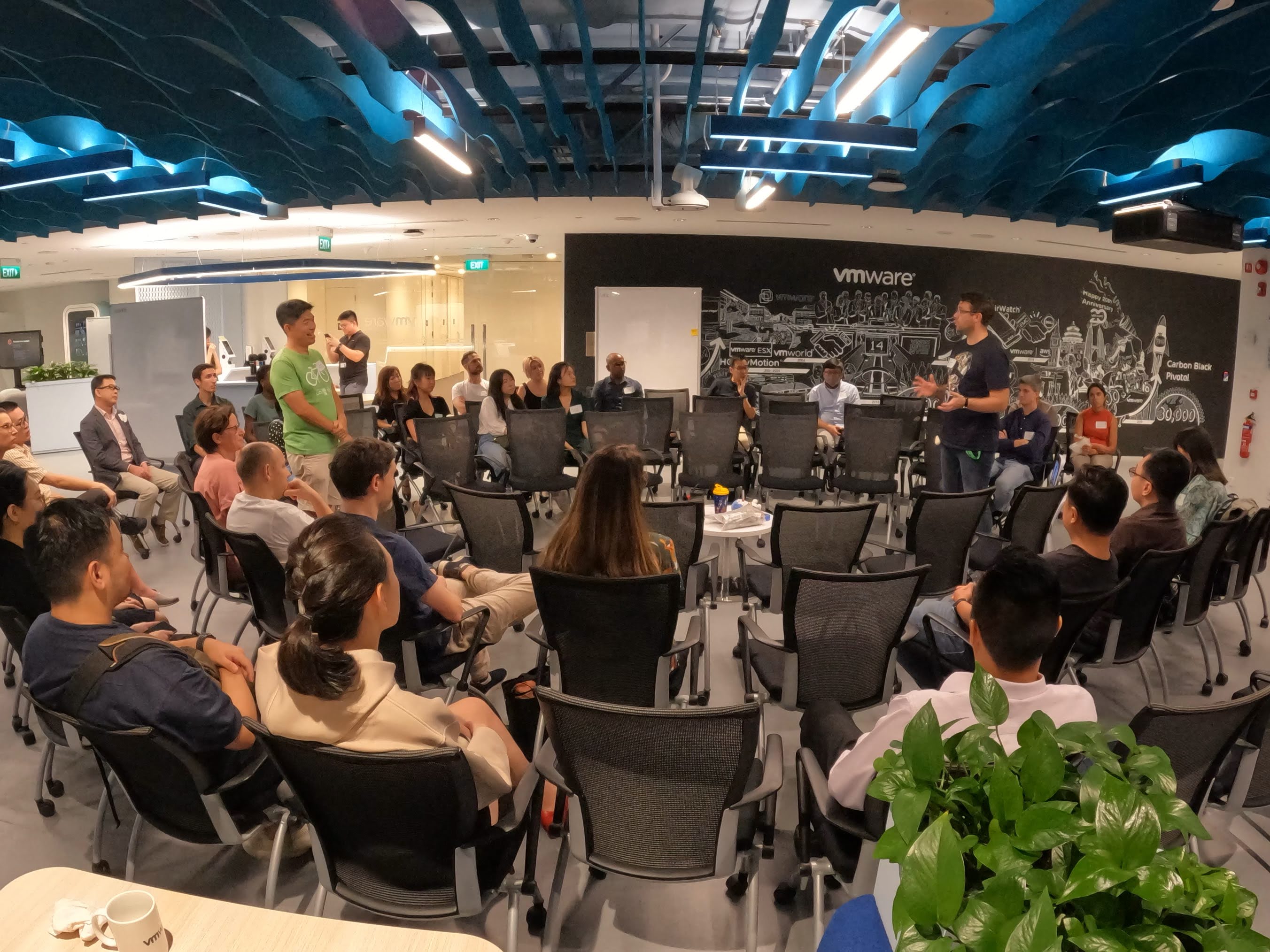
Our work with Opening Space for Sustainability widened the field.
The conversations were no longer only about designing more sustainable products. Participants began exploring climate action, circularity, education, food and soil systems, regenerative practice, organisational resistance and the assumptions underneath economic growth.
The questions became both practical and personal:
- What does sustainability mean in our everyday lives?
- What makes meaningful change difficult inside organisations?
- How do we move from awareness to action?
- What happens when sustainability is treated as another performance indicator rather than a relationship with the living systems around us?
These gatherings helped us see that sustainability could not be separated neatly from community.
Change requires knowledge, but it also requires trust, courage, shared language and people willing to continue showing up.
Learning to design the conditions

The 2023 Product Tonic Unconference at Ground-Up Initiative became an important experiment in how such a community might gather.
Twenty-one volunteers used Open Space as a way to co-design the experience itself. They explored their motivations, learning intentions, skills and possible contributions before distributing responsibilities across hosts, co-hosts, guardians, topic hosts and scribes.
The roles did more than organise the event.
- They distributed different forms of care.
- Some people cared for the rhythm of the day.
- Some welcomed and grounded participants.
- Some held the physical and relational space.
- Some hosted questions.
- Some captured the collective memory.
This enabled 84 participants to shape the agenda together while still experiencing enough structure, continuity and support to participate meaningfully.
The lesson was not that everything should be left unplanned.
It was that structure could be used to support agency rather than replace it.
From Chaos to Surprise
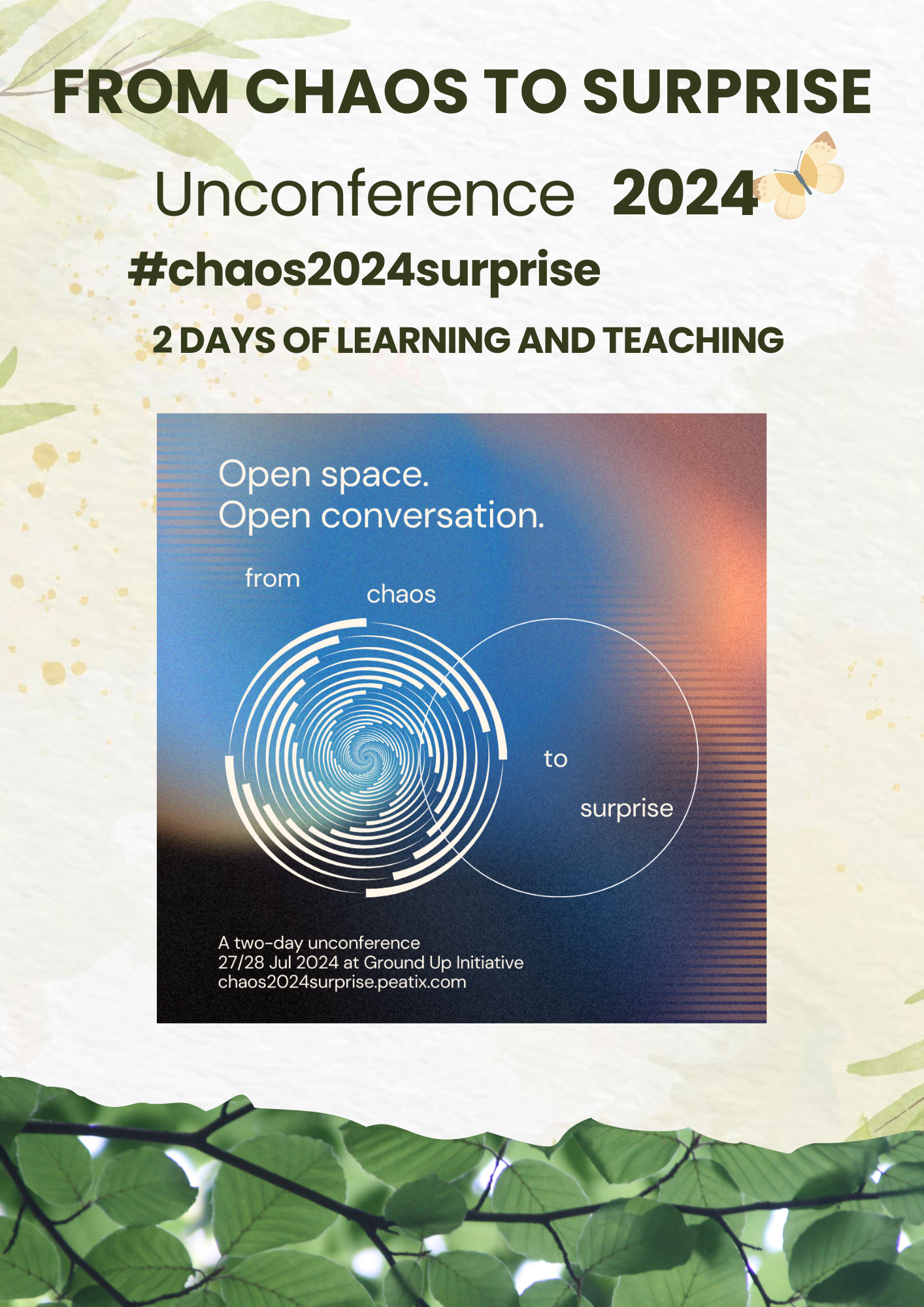
In July 2024, we returned to GUI for the two-day From Chaos to Surprise learning unconference.
Before the gathering, we imagined conversations around community building, sustainability, future thinking, product leadership and organisational development.
What actually emerged shifted the centre of gravity.
Across 29 participant-generated topics, three themes became visible:
🌿 Well-being and Self-Expression
🌍 Sustainability and Systemic Change
🤝 Community Building and Personal Growth
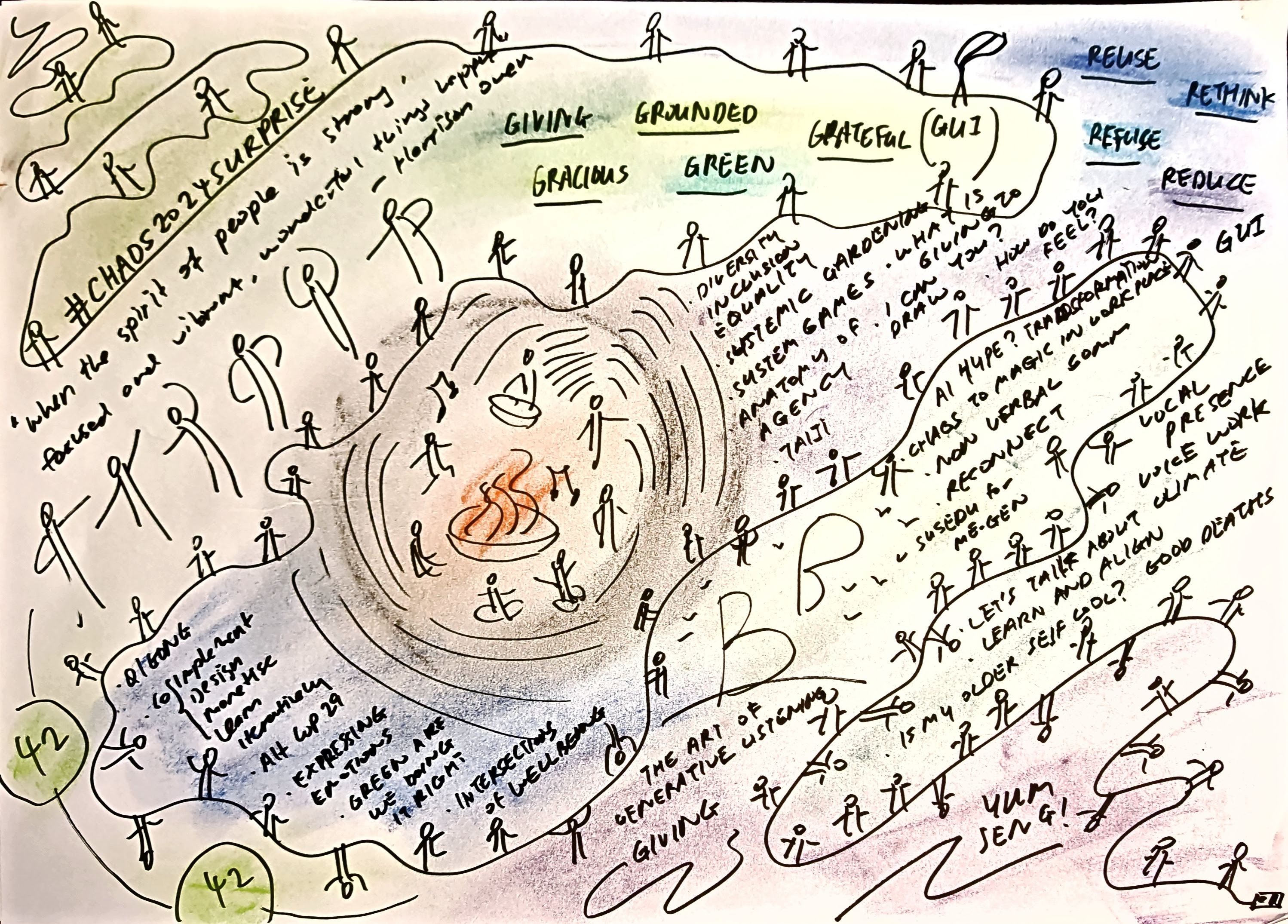
The programme included Qigong, Taiji, voice, movement and emotional expression alongside conversations about climate, systemic gardening, AI, agency, inclusion, ageing, generative listening and death.
The community did not reject the professional and systemic questions we arrived with.
It revealed what else needed to be present.
- Bodies.
- Emotions.
- Relationships.
- Meaning.
- Mortality.
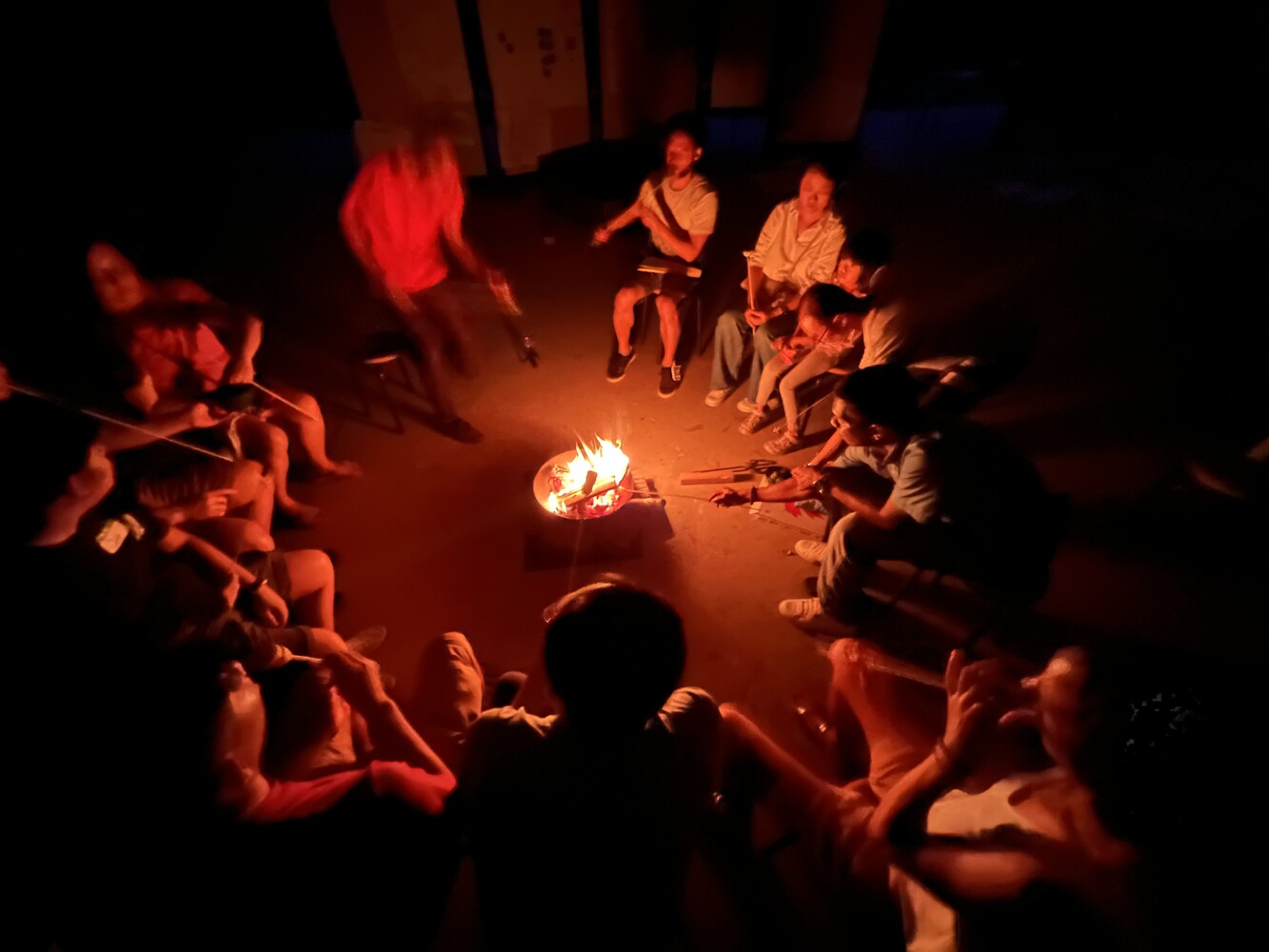
The proceedings show a gathering in which learning happened through dialogue, drawing, movement, food, walking, storytelling and the campfire—not only through formal discussion.
This became one of the clearest lessons from the weekend:
When people are given enough freedom and care, they often surface questions deeper than the ones organisers originally imagined.
From contribution to stewardship
Another small but meaningful experiment was the Wall of Giving.
Participants offered coaching, facilitation, visual storytelling, movement practices, mentoring, walks and other capabilities in support of Ground-Up Initiative.
The gathering eventually raised $2,435.45 towards GUI’s #1000GUIConnections campaign.
But the significance was not only the amount raised.
The Wall invited people to notice that value already existed within the community.
A person might not have considered themselves a donor or sponsor. Yet they could still ask:
- What can I offer?
- Who might benefit from it?
- How could part of that value circulate back towards the wider community?
This points towards a distinction we are continuing to explore:
Contribution asks what I can give.
Stewardship asks what the whole may need—and how I can care for it over time.
An unconference makes contribution relatively easy. People can host a session, share a practice, document a conversation or help another participant.
Stewardship is a longer practice.
It asks us to remain in relationship after the immediate energy of the gathering has passed.
The Collab Folks as a place of inquiry
The Collab Folks emerged as a place to explore this deeper layer of the work.
- How do people collaborate when the situation is uncertain?
- How do we recognise the survival rules, identities and relational patterns we carry into groups?
- How do we navigate tensions without forcing one side to defeat the other?
- How do facilitators create enough structure for people to feel supported while preserving enough freedom for something unexpected to emerge?
- How do we work with differences in power, access, confidence and experience?
These are not questions that can be resolved through a single framework or event.
They require practice.
They also require places where people can return, reflect on what happened, experiment again and learn alongside others.
That is the emerging need behind Weaving Futures.
What Weaving Futures may become

Weaving Futures is currently taking shape as a public practice space across Singapore and Southeast Asia.
The intention is not to build another community with a rigid identity, membership boundary or predetermined body of knowledge.
Nor is it simply a new name for an annual unconference.
We are exploring an ecosystem with several possible forms:
- public gatherings where people can surface questions and meet collaborators;
- small practice labs where participants can build capability over several weeks;
- spaces for facilitators to practise hosting and receive reflection;
- youth-led inquiries into agency, belonging and the futures they are inheriting;
- transition spaces for people navigating changes in work, identity, community and life;
- continuing circles around sustainability, stewardship and systemic change;
- ways for participants to offer time, skills, relationships and resources without reducing everything to a transaction.
Our next public doorway will be a two-day Weaving Futures Unconference on 17–18 October 2026 at Ground-Up Initiative.
Open Space will remain important because it allows the people present to shape the agenda.
But the larger inquiry goes beyond those two days:
How might the gathering become part of a longer learning journey rather than an isolated experience?
- Some conversations may become practice labs.
- Some may develop into participant-led experiments.
- Some may connect existing communities that have been working separately.
- Some may remain as one meaningful encounter.
Not everything needs to scale.
Not every seed needs to become a project.
The task is to create enough possibility for people to notice what deserves further care.
Three shifts we are trying to make

From events to practice spaces
An event has a beginning and an ending.
A practice space allows people to return, notice their development and deepen relationships over time.
The unconference may open the field. The labs and circles can help people remain with what surfaces.
From participation to stewardship
Participation asks people to attend and contribute.
Stewardship invites people to notice the health of the larger ecosystem: who is absent, who needs support, what is becoming over-dependent on a few individuals, and what needs to be renewed.
From predetermined outcomes to developmental capacity
We cannot predict every challenge our communities will face.
We can, however, strengthen our ability to listen, collaborate, navigate tension, host difficult conversations and act with greater awareness.
The desired outcome is not one shared answer.
It is greater collective capacity to respond.
A continuing lineage
Product Tonic, Opening Space for Sustainability and The Collab Folks have each contributed something to this journey.
Product Tonic taught us how a professional community might become a relational one.
Opening Space for Sustainability widened our attention from products and organisations towards living systems and shared responsibility.
The Collab Folks helped us inquire more deeply into facilitation, relationships, personal growth and the practice of community weaving.
Weaving Futures is not intended to replace these histories.
It is an attempt to gather their learning and carry it into a new form.
- From products to people.
- From events to relationships.
- From participation to stewardship.
- From organising communities to learning how to weave them.
The space between what has been and what comes next
We do not yet know exactly what Weaving Futures will become.
That uncertainty is not something we need to hide.
It may be one of the conditions that allows the work to remain alive.
We can offer an intention, some initial structures and a place to gather.
The people who enter will bring questions and possibilities we cannot anticipate.
Our responsibility is not to control what emerges.
It is to create conditions where people can encounter one another meaningfully, take responsibility for their learning and recognise what they may be ready to steward together.
The future is not merely something that happens to communities.
It is something communities learn to notice, enter and shape.
Together.
This article continues a reflection that began with From Chaos to Surprise: A Journey in Co-Designing a Learning Unconference, published on Product Tonic Medium.
🍂 Weaving Futures Launch Gathering
17–18 October 2026
Ground-Up Initiative (GUI), SingaporeLearn more at https://luma.com/weaving-futures-2026

